The Missed Mortgage Payment Timeline
Each stage below has its own trigger and its own consequence. The useful thing to work out early is which stage you are actually in, because the options narrow at every one of them.
| Stage | When | What It Means |
|---|---|---|
| Grace period | Days 1 to 15 | Most mortgage contracts allow up to 15 days before a late fee is charged; no credit reporting yet |
| Late fee charged | Day 16 or later | Servicer can charge a late fee, typically 4 to 6 percent of the missed payment |
| Credit reporting | Day 30 | Missed payment reported to credit bureaus as 30 days late |
| Live contact required | By day 36 | Federal law (12 CFR 1024.39) requires servicer to attempt live contact to discuss loss mitigation |
| Written notice required | By day 45 | Servicer must send written information about loss mitigation options |
| Earliest Notice of Default | Day 120 | Federal rules prohibit foreclosure proceedings before 120 days past due (12 CFR 1024.41) |
| Reinstatement period (CA) | 90 days after Notice of Default | California gives 90 days to pay all amounts owed and stop the foreclosure entirely |
| Notice of Trustee's Sale | After reinstatement period | Auction must be scheduled at least 21 days after this notice is recorded |
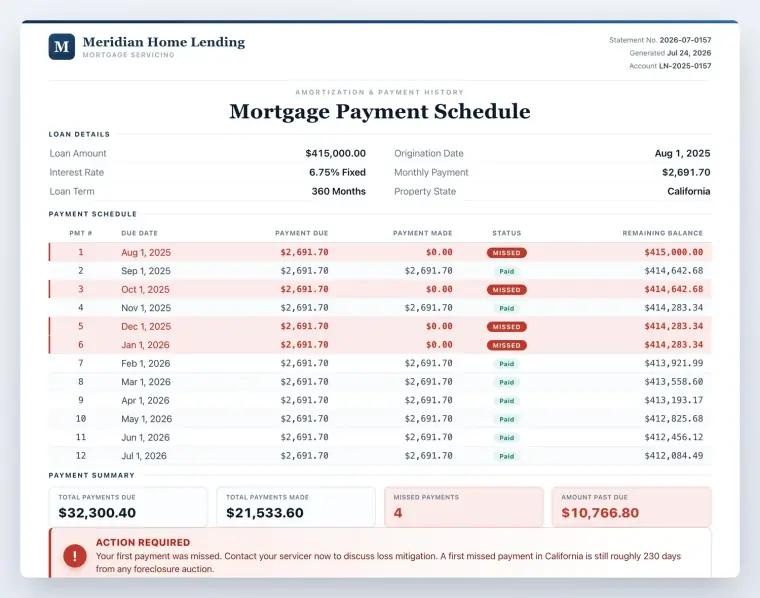
The fastest lawful path from a first missed payment to auction in California is roughly 230 days.
The First 30 Days: Grace Period and Late Fees
Most mortgage contracts include a grace period of 15 days. If you bring the loan current within that window, no late fee is charged and no negative information reaches the credit bureaus. After day 15, your servicer can charge a late fee, typically between 4 and 6 percent of your monthly payment. At day 30, the missed payment is reported to the credit bureaus as a 30-day late mark.
That mark will lower your credit score, sometimes significantly. But a 30-day late mark is not a foreclosure, and it does not trigger any legal process. The distance between where you are at day 30 and where foreclosure actually begins is measured in months, not days.
Why the Payment Changed, and What the Credit Damage Looks Like
Not every missed payment follows a drop in income. The most common surprise is an escrow shortage: property taxes or the hazard insurance premium rose, the servicer recalculated the escrow portion, and the monthly payment went up without the loan itself changing at all. If your payment jumped and you are not sure why, ask the servicer for the current escrow analysis before assuming the worst. A shortage can often be spread across twelve months rather than demanded at once.
On credit, the thirty-day mark is the one that matters, but it is not the end of the escalation. Each further thirty days of delinquency is reported separately and the damage compounds, and the record persists for years after the account is brought current. Catching up before day thirty generally keeps the late payment off the report altogether, which is why the first month is worth more than any month that follows it.
How a missed payment escalates on your credit file
| Stage | What happens |
|---|---|
| Within the grace period | No late fee, nothing reported |
| After the grace period, before day 30 | A late fee applies, but generally nothing is reported to the bureaus yet |
| 30 days late | The first delinquency is reported; this is the meaningful threshold |
| 60 and 90 days late | Reported separately at each stage, with compounding damage |
| 120 days late | The federal floor lifts and formal foreclosure can begin |
Ask the servicer whether bringing the account current stops further reporting. It does not erase what has already been furnished, but it stops the escalation, and that part is still within your control.
What Federal Law Requires Your Servicer to Do
Once you are delinquent, federal law places specific obligations on your mortgage servicer. Under 12 CFR 1024.39, the servicer must make good-faith efforts to establish live contact with you no later than day 36 of delinquency and promptly inform you of available loss mitigation options. By day 45, the servicer must also send you written information covering those options: loan modification, repayment plans, and forbearance.
Under 12 CFR 1024.41, no servicer can begin formal foreclosure proceedings until you are at least 120 days past due. That four-month minimum is the federal floor and your primary protected window to work with your servicer or, if necessary, to sell.
The same rule carries a protection most homeowners never hear about. If you submit a complete loss mitigation application in time, your servicer generally cannot conduct a foreclosure sale while that application is pending and under review. This is the dual-tracking restriction, and it is why a completed application matters far more than a phone call: an incomplete file buys you nothing, while a complete one can halt the sale. Ask the servicer in writing which documents are still outstanding, and get written confirmation of the date your application was treated as complete.

"The biggest mistake that homeowners can make is to wait, because your options are very often time sensitive."
Jennifer Fraser, Director of Stakeholder Engagement and Grants, GreenPath Financial Wellness, as quoted in PBS NewsHour
How California's Foreclosure Process Begins
At 120 days past due, the servicer can record a Notice of Default (NOD) with the county recorder's office. California law also requires the servicer to contact you at least 30 days before recording the NOD to discuss options including loan modification. After the NOD is recorded, you have a 90-day reinstatement period. Paying all amounts owed during that window, including late fees and trustee costs, stops the foreclosure entirely. If you do not reinstate, the trustee records a Notice of Trustee's Sale and schedules an auction at least 21 days later.
You own your home through all of this. Your right to sell it remains intact until the auction closes and the trustee accepts a bid.
Loss Mitigation Options: what to ask your servicer at each stage
| Option | When Available | What to Ask For |
|---|---|---|
| Repayment plan | Before or after Notice of Default | Ask to spread missed payments across future monthly payments over several months |
| Forbearance | Before or after Notice of Default | Ask to temporarily pause or reduce payments for a defined period |
| Loan modification | Before or after Notice of Default | Ask to permanently change loan terms such as the interest rate, loan term, or principal balance |
| Short sale | When the home is worth less than what is owed | Ask if the servicer will accept a sale price less than the full payoff amount |
| Deed in lieu of foreclosure | When other options are exhausted | Offer to voluntarily transfer title to the lender to avoid the auction |
| Cash sale (pre-foreclosure) | Any time before the auction closes | Sell the home as-is to a cash buyer; proceeds pay off the loan and any equity above the payoff goes to you |
A HUD-approved housing counselor can help you identify which options your servicer is required to consider. Call 1-800-569-4287 for free assistance.
What Your Loan Type Changes
The options above are the general menu, but which of them you are actually offered depends on who backs your loan. This is the question to answer first, because an FHA borrower and a conventional borrower in identical situations get offered different things. If you do not know which you have, the servicer can tell you, and it is on your closing paperwork.
Loss mitigation by loan type: what to ask for by name
| Loan type | What is distinctive |
|---|---|
| FHA | The partial claim: HUD advances the arrears as an interest-free subordinate lien repaid when you sell or pay off the loan, moving the missed payments off your monthly budget entirely. Ask for it by name |
| VA | VA loan technicians can intervene with the servicer on your behalf, and VA publishes its own repayment and modification options for veterans in default |
| USDA | Rural Development guaranteed loans run their own loss mitigation program, including moratorium relief in some hardship cases |
| Conventional | Loans backed by Fannie Mae or Freddie Mac have standardized modification programs; ask the servicer which investor owns the loan, because that determines the program |
A HUD-approved housing counselor can identify your loan type and the matching program at no cost, which is usually faster than working it out from the servicer's phone tree.
When Selling Becomes the Right Answer
If keeping the home is not possible, selling before the auction preserves whatever equity you have built. A completed foreclosure can remain on your credit report for up to seven years and significantly affects your ability to qualify for a future mortgage. Selling resolves the debt cleanly and prevents the foreclosure notation from appearing on your credit record at all. You do not need the lender's permission when the sale pays the loan in full, which is how selling during a California foreclosure works.
If you have equity in a home in Temecula or Southwest Riverside County, a cash buyer can close on a timeline that works around your foreclosure deadlines, with no repairs required and no listing period. Out of Your House buys as-is for cash throughout the area and lets you set the closing date. Get a no-obligation cash offer here. If staying in the home is still a real possibility, a HUD-approved housing counselor can walk through every option with you at no cost: 1-800-569-4287. If things have already moved further along, the foreclosure clock guide covers the deadlines that follow, and the hard money guide explains why borrowing your way out usually costs more than it buys.
Sell Before Auction vs. Completed Foreclosure: side-by-side comparison
| Outcome | Sell Before Auction | Completed Foreclosure |
|---|---|---|
| You receive equity above what is owed | Yes. Net proceeds (sale price minus payoff and costs) go to you. | Possibly none. Auction price minus payoff and trustee costs may leave little or nothing. |
| Foreclosure notation on credit report | No. Late payment marks appear, but no foreclosure notation is added. | Yes. A completed foreclosure can remain for up to 7 years per the CFPB. |
| Waiting period for next mortgage | Potentially shorter, depending on loan type and lender. | Typically 3 to 7 years depending on loan type. |
| You control the closing date | Yes. | No. |
| Home must be repaired or staged | No, if selling as-is to a cash buyer. | Not applicable. |
Frequently Asked Questions
Does missing one mortgage payment mean I will lose my home?
No. One missed payment starts a required sequence of notices and waiting periods, but foreclosure cannot legally begin for at least 120 days under federal law. California's process adds another 90-day reinstatement period after the Notice of Default, plus at least 21 days before the auction. Acting early, whether by contacting your servicer or exploring your options, gives you the most time and flexibility.
What is the grace period on a mortgage payment?
Most mortgage contracts include a grace period of 15 days after the payment due date. If you pay in full within those 15 days, no late fee is charged and no negative information is reported to the credit bureaus. After the grace period expires, the servicer can charge a late fee, typically between 4 and 6 percent of the missed payment. At 30 days past due, the missed payment is reported to the credit bureaus.
Can I catch up after missing a mortgage payment?
Yes, and the sooner the better. Bringing the loan current before 30 days past due prevents credit bureau reporting entirely. After 30 days, the mark is already reported, but curing the delinquency stops the escalation toward foreclosure. Even after a Notice of Default is filed in California, you have a 90-day reinstatement window to pay all amounts owed and stop the process entirely. Contacting your servicer as early as possible opens the most options.
How long does a foreclosure stay on your credit report?
A completed foreclosure can remain on your credit report for up to seven years from the date of first delinquency, according to the CFPB. That notation affects your ability to qualify for future mortgages and may require a waiting period of three to seven years depending on the loan type. Selling the home before the foreclosure completes avoids this notation entirely, even though the missed payment marks remain on the report.
Does it matter whether my loan is FHA, VA, or conventional?
Yes, more than most people expect. Your loan type determines which loss mitigation options you can be offered. FHA borrowers can ask for a partial claim, where HUD advances the missed payments as an interest-free subordinate lien repaid only when you sell or pay off the loan. VA borrowers can have a VA loan technician intervene with the servicer directly. USDA and conventional loans each run their own programs. Find out which one you have before you call the servicer, and ask for the matching program by name.
About Missed Mortgage Payments
- CFPB: If I cannot pay my mortgage, what are my options?
- eCFR: 12 CFR 1024.39, early intervention requirements for delinquent borrowers
- HUD: Avoiding Foreclosure, resources and approved counseling agencies
- CFPB: Your mortgage servicer must comply with federal rules
Sources: eCFR 12 CFR 1024.39 (early intervention requirements), eCFR 12 CFR 1024.41 (loss mitigation and dual tracking), VA: help for veterans having trouble making payments, CFPB: what a mortgage escrow account is, CFPB 12 CFR 1024.39 regulations, CFPB: Your mortgage servicer must comply with federal rules, HUD: Avoiding Foreclosure, PBS NewsHour: What experts recommend when worried about your mortgage payment